SLIDING AROUND THE WORLD
 
Legong: Dance of the Virgins (1935)
 
Para ver el texto en español, desplácese hacia abajo

“Come, smile, my child. This is the day of your last Temple dance. Soon you will wear the bridal sarong.”Director: Henri de la Falaise, Robert Sidney


MIKE COOPER performs a live soundtrack composed for lap steel guitar, processed field recordings (from Bali,Thailand and Sarawak) thumb pianos and sampled small gongs.
 
On the day of the temple feast of Tampaksiring, Poutou, a young maiden who performs the LEGONG, the dance of the virgins at the sacred temple, meets Njong, a carefree youth from Northern Bali. As they gaze at each other, she remembers a prophecy that warned “Should love enter thine eyes and go to thy heart, beware. For should he whom thou choosest not return thy love, thy gods will frown and disgrace will befall thee…”
 
This film, shot in 1933 in Ubud in Bali when Bali had become THE place to be. Extolled as a paradise on Earth with beautiful (mostly topless) natives and an exotic culture, the small island was soon swarming with the rich and famous. When the Marquis Henri de la Falaise de la Coudray–or “Hank” to ex-wife Gloria Swanson and current wife/producer Constance Bennett–arrived in Bali with a Technicolor crew in 1933, there had already been a slew of “documentaries” that reaped box office success in the United States. Directed by the dilettante husband of two famous movie stars, how good could the film be?
 
Slashed apart by censors around the world, LEGONG quickly disappeared and was forgotten.With its impressive sensitivity to Balinese customs (the dance and religious rituals they filmed have become extremely important for their ethnographic value alone) and an eye for the natural beauty of the island, the film ranks with F.W. Murnau’s TABU ( another of Cooper’s live film/music presentations) as an enduring masterpiece of tropical splendor. LEGONG is a feast for the eyes and the imagination.
 
The film is particularly important for capturing the splendor of the costumes, dances and decorations of the temples in Technicolor before they became spoiled by commercialization. Viewed from this perspective, it’s a fascinating piece of anthropology The limitations of two-strip Technicolor (which includes red and green only, and cannot reproduce blue well) aren’t readily apparent due to the lush green jungles and the golds and reds of the costumes.
 
The actors are all locals essentially playing themselves for the most part. This was one of the last silent feature films to be released commercially (as well as one of the last two-strip Technicolor features). The intertitles themselves are gorgeous works of art, created by noted Mexican artist Miguel Covarrubias, with their stylized and striking ornamentation.
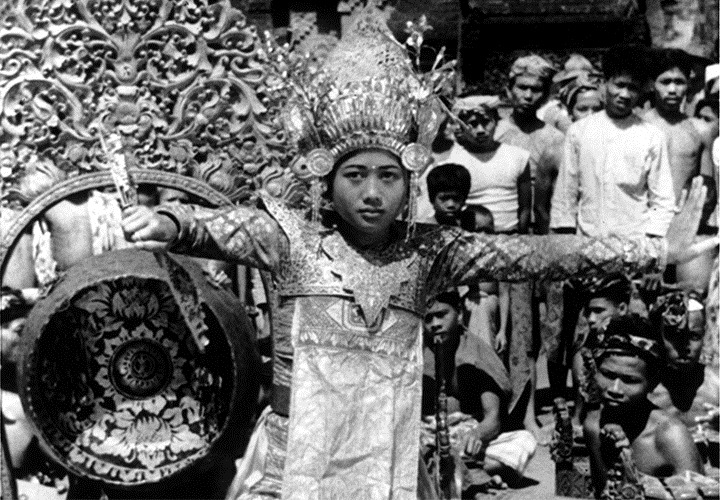
 
LEGONG PHOTO
 
 
Legong: La danza de las vírgenes (1935)
“Ven, sonríe, hija mía. Este es el día de tu última danza en el templo. Pronto llevarás el pareo nupcial”: Henri de la Falaise, Robert Sidney
MIKE COOPER interpreta una banda sonora en directo compuesta por lap steel guitar, grabaciones de campo procesadas (de Bali,Tailandia y Sarawak) pianos de pulgar y pequeños gongs muestreados.
El día de la fiesta del templo de Tampaksiring, Poutou, una joven doncella que ejecuta el LEGONG, la danza de las vírgenes en el templo sagrado, conoce a Njong, un joven despreocupado del norte de Bali. Mientras se miran, ella recuerda una profecía que advertía: “Si el amor entra en tus ojos y llega a tu corazón, ten cuidado. Porque si el que eliges no te devuelve el amor, tus dioses fruncirán el ceño y la desgracia caerá sobre ti…”
Esta película, rodada en 1933 en Ubud, en Bali, cuando Bali se había convertido en EL lugar para estar. Exaltada como un paraíso en la Tierra, con hermosas nativas (la mayoría en topless) y una cultura exótica, la pequeña isla pronto se llenó de ricos y famosos. Cuando el marqués Henri de la Falaise de la Coudray -o “Hank” para su ex esposa Gloria Swanson y su actual esposa/productora Constance Bennett- llegó a Bali con un equipo de Technicolor en 1933, ya había habido una serie de “documentales” que cosecharon éxitos de taquilla en Estados Unidos. Dirigida por el diletante marido de dos famosas estrellas de cine, ¿qué tan buena podía ser la película?
Con su impresionante sensibilidad hacia las costumbres balinesas (las danzas y los rituales religiosos que filmaron se han convertido en algo muy importante sólo por su valor etnográfico) y su ojo para la belleza natural de la isla, la película se sitúa junto a TABU de F.W. Murnau (otra de las presentaciones de cine y música en directo de Cooper) como una obra maestra perdurable del esplendor tropical. LEGONG es una fiesta para los ojos y la imaginación.
La película es especialmente importante por haber captado el esplendor de los trajes, los bailes y las decoraciones de los templos en Technicolor antes de que se estropearan por la comercialización. Las limitaciones del Technicolor de dos bandas (que sólo incluye el rojo y el verde, y no puede reproducir bien el azul) no son evidentes debido a las exuberantes selvas verdes y a los dorados y rojos de los trajes.
Los actores son todos lugareños que se interpretan a sí mismos en su mayor parte. Este fue uno de los últimos largometrajes mudos que se estrenaron comercialmente (así como uno de los últimos largometrajes en dos bandas de Technicolor). Los propios intertítulos son magníficas obras de arte, creadas por el célebre artista mexicano Miguel Covarrubias, con su estilizada y llamativa ornamentación.