The following are some of the stories behind some of my records and compositions ( there is always a story) travel tales and other ramblings. They were initially started under the heading My Life As A Beachboy which made reference to my record Reluctant Swimmer / Virtual Surfer a vinyl release on Discrepant records which we will come to later on.
To begin lets start with Raft my vinyl release on Room40 records. RM484 July 7, 2017.

Raft One – Age Unlimited – William Willis
Basement Books in Melbourne. A treasury of second hand books that I visit regularly whenever I am in that city. I head straight for the Travel – Pacific section. My library is stuffed with volumes that I bought in that ‘beach beneath the street’. This particular day I am drawn to a small volume titled The Seven Sisters by William Willis because it has what looks like a raft embossed in the righthand bottom corner of the cover in gold. I had been assigned to read The Kon Tiki Expedition at school in my last few years there. That and The Tempest by William Shakespeare were my English Literature Exam books. Easy, inspiring and obviously impressive to me. Thor Heyerdahl was all I knew about rafting and the Pacific until William Willis came into my hands. Here was a man who had sailed 2,200 miles further than Heyerdah across the Pacific Ocean so how come no one talked about him and why did he not have a million tourists visiting a museum dedicated to him like Heyerdahl’s in Oslo I wondered.
In 1954 just seven years after Heyerdahl had drifted with his crew of five across the Pacific from Peru to the Tuamotu Islands Willis drifted as far as Samoa from Callao single handedly!! He was 61 years old at that time and had suffered a hernia the day he left. He continued to be plagued by this throughout the voyage and at one point even had to hang himself upside down with a rope around one ankle suspended from a sail spar to relieve himself of pain and put his intestine back inside. His diet for almost the whole voyage was 50 pounds of Canihua grain, 70 pounds of Barley, 70 pounds of brown sugar, 50 cans of lemon juice, 2 pounds of tea, 50 cans of instant coffee and 120 gallons of fresh water. He claims that he hardly ever even saw fish let alone caught them and that practically the only ones he did eat were flying fish that happened to land on the deck by mistake and that the cat he had taken with him (as well as a parrot) didn’t get to eat first. The cat incidentally completed the whole trip with Willis but the parrot was killed by the cat a couple of days before completion of the voyage. it had taken Willis 115 days to sail the 6,700 miles. Willis left his raft and bequeathed it to the Samoans who built a small museum around it which it seems burnt down at some point. The raft itself was built from seven balsa wood tree trunks and Willis had named it Seven Little Sisters.
Ten year later when Willis was 73 he built another raft based on his first and left Callao in Peru on 5th July 1963 with the intention of a complete crossing to Australia. He arrived in Apia where he made a lengthy repair stop before continuing on towards has final goal. After 204 days of rafting he arrived in Tully in northern Queensland on the east coast of Australia, after a treacherous crossing of the Great Barrier Reef. From Tully his raft was towed, with almost disastrous results, down the coast to Sydney where he made a glorious entry under Sydney Harbour Bridge. Rafts do not take kindly to being towed, preferring to take their time under their own motivation. After all his raft was named Age Unlimited.
https://youtu.be/q0bDGfTU6iQ?si=N7JiWWF-mbpSQAWs
Willis unfortunately came to an inglorious end attempting to cross the Atlantic in May 1968 in a small sailing boat. It was not the first time he had tried this and his boat was found drifting half submerged 400 miles from the Irish coast, but Willis was never found only his journal with a final entry on July 21st 1968. It had been drifting, presumably without Willis for two months.
RAFT TWO – Vital Alsar La Balsa y Las Balsas
Vital: “necessary for the success or continued existence of something; extremely important”
Where to begin. Basement books again? The Maritime Museum in Ballina? A dumpster in the street in Valencia. Where to end …..Vera Cruz maybe..or in reverse perhaps, or both beginning and ending?
Vera Cruz is famous for the quality of its hot chocolate best consumed maybe at La Parroquia de Veracruz in the port, which is where we went. Worth it if only for the theatre of pouring. In fact there is nothing special about the place at all and it is almost always crowded and you wait to be seated. Which we did. And the pouring is spectacular and very similar to the pouring of cider, or Sidra or Sagardoa, as it is known in the Asturian, Basque and Galician areas of Spain, or Cantabria which is where Vital Alsar was born.
Again searching the arcane Pacific section in Basement books in Melbourne where I had discovered William Willis I pull out a volume that has on its spine “La Balsa To Australia – The Longest Raft Voyage In History” by Vital Alsar.
This tells me the story of Vital’s third, and second successful, trip drifting across the Pacific. He was of course familiar with the Non Tiki expedition, having read it in, of all places, Morocco, when doing military service in the Spanish Army and felt the urge to replicate it.
In 1966 he made, in the now established tradition of Pacific rafters, a balsa wood raft which sank after 143 days with Vital and crew member and friend Marc Modena being rescued by a passing ship near the Galapagos Islands. That raft was named Pacifica. In 1970 La Balsa is launched in the Rio Guayas with four men on board and was being towed towards the Gulf Of Guayaquil and the open ocean for the start of what would become the longest non stop journey by raft ever made. William Willis had also achieve this remember, but although he was alone he had made a lengthy repair stop in Apia in Samoa.
The two had met at the explorers club in Manhattan prior to Vital’s Pacifica raft excursion where Willis had told Vital it was impossible, but then changed his mind later and said that he thought Vital might make it.
Vital and his crew took 161 days to navigate the La Balsa Pacific and arrive in Mooloolaba in Queensland on the East Coast of Australia about 97 kilometres north of Brisbane.
https://www.sea.museum/2020/07/16/las-balsas-the-worlds-longest-raft-journey
Ballina – A mostly retirement town 160 kilometres south of Brisbane on the Richmond River which empties into the Pacific Ocean at Ballina. It has two surf beaches the North Wall and the South Wall. The South Wall is a winter surf beach whereas The North Wall is a summer surf beach and has a permanent shark warning, which does not deter most surfers. Its other claim to fame is the worlds biggest prawn model which used to sit atop a restaurant in former years. The restaurant closed and for may years the Big Prawn was deserted but the actual prawn sat there until a hardware chain, Bunnings, bought the site and rescued the prawn which now sits beside its carpark entrance.

Unsettled.
Ballina normally has a copious 1,817.9 mm (71.6 in) of rainfall annually, but during my 2017 tour of Australia a cyclone crossed the north eastern coast of Australia and travelled slowly south, eventually ending up in New Zealand causing very extreme flooding. I was due to give an audio visual concert with my colleague Grayson Cooke, who lives in Ballina, at Southern Cross University in Lismore where he works. Lismore was inundated with several metres of floodwater; the university was closed, roads impassable, raging river, floating islands of debris from the hinterlands sailing past the window (his apartment is right on the river) and the concert is cancelled. Instead we decided to do a ‘live stream’ on social media from Grayson’s apartment. I had travelled on this tour with no guitar, my usual instrument and was borrowing one from someone wherever I played. But I had my iPhone with a virtual digital steel guitar app installed, hooked up to my mini Kaos Pad, a long delay pedal, and a Samsung tablet with a John Cage prepared piano app. Grayson screened and manipulated video from his Unsettled audio visual installation (for which I did the music) that was at that time being show in Adelaide at the same time. I released the resulting audio on my Bandcamp page.
Prior to the cyclone arriving, or maybe on a previous visit to Ballina, I was admiring pelicans nesting on the top of a lamp post alongside the river when I noticed I was outside a building advertising itself as the Ballina Naval and Martime Museum. Why not enter? Totally surprised to see inside a balsa wood raft, but not just any old balsa wood raft it was THE raft. One of three that in 1973 Vital Alsar had sailed across the Pacific Ocean with 12 comrades from Ecuador to Ballina for the second time. Guayaquil to Ballina. This third voyage in 1972 featuring three rafts reached Ballina on the east coast of Australia after 179 days. One of the three rafts began to break up when the Australian navy attempted to tow it ashore. The other two were moored in the Richmond river for some months until they discovered that they were starting to rot. The raft presently in the Ballina Maritime Museum is a composite of the two.
While I was writing this in 2020 Vital died on the 15th September aged 87. His life after the epic raft voyages continued to be dedicated to the sea and sailing. In 1977,he built 3 brigs in Guayaquil navigating the Amazon river and the Atlantic Ocean, 11,000 nautical miles, until reaching Santander in Spain. The brigs can be seen in the Magdalena Palace in Santander as can a replica raft as well. His last expedition was “Zamná”, sailing from the island of Cozumel (Mexico) to Greece, stopping at many American, European and North African ports before returning to Mexico. This last voyage between 2009-2010 aboard the trimaran was built in the port of Alvarado and named Zamná after the Mayan god of knowledge. Aboard was a Mayan boy, his father and twelve other crew members carrying an emotional message of peace – “El Niño, La Mar and La Paz”. Sail on, sail on sailor.
Mike Cooper Copyright July 2022.
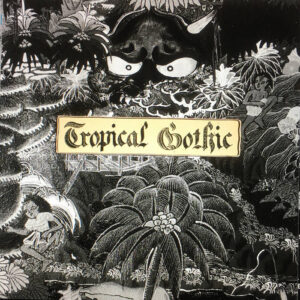
TROPICAL GOTHIC – https://mikecooper.bandcamp.com/album/tropical-gothic-onibaba-legong-gods-of-bali
“Gothic – relating to a style of fiction characterized by the use of desolate or remote settings and macabre, mysterious, or violent incidents.”
The title ‘Tropical Gothic’ first came up as shared black and white photographs, mostly of palm trees, initiated by my friend Lawrence English. We began to exchange similar images and eventually from my part they began to include images other than palm trees, such as contemporary beach side architecture for example. Another subject yet to be explored-
When I investigatedTropical Gothic on line as a genre a collection of short stories came up with that title plus The Woman Who Had Two Navels And Tales Of The Tropical Gothic by the Filipino writer Nick Joaquin.
Following more links I came across a blog, ‘Tropical Gothic’ from Daniel Sa where he writes –
“Establishing the concept of Tropical Gothic as a critical term to investigate specific cultural traditions of the supernatural and the strange in the warmer parts of the globe is not an easy task. At first glance the expression itself seems to be rather contradictory; an oxymoron that combines the opposing ideas of ‘solar’ and ‘gloom’ in one concept. Academics that do not work in the field of Gothic Studies question the value of applying the Gothic – a literary and critical term originated in Britain – to the investigation of texts from other traditions.” He goes on to say that some argue that “..the category of Magic Realism already covers the tradition of the supernatural and the strange.”
The Gothic Imagination –
“Tropical Gothic examines Gothic within a specific geographical area of ‘the South’…as well as trans-national movements of the Gothic…Tropical Gothic includes, but is by no means limited to, a reflection on a region where European colonial powers fought intensively against indigenous populations and against each other for control of land and resources.”
Louis Becke (1855-1913) was an Australian writer who spent most of his life as a sailor, trader and short story writer moving around the Pacific Islands where most of his stories are set; fiction based mostly on his personal experiences with blackbirding (kidnapping) pirates, south sea islanders, pearl divers, unscrupulous white colonial traders and wild characters in general of both sexes. https://archive.org/details/notesfrommysouth00beck/page/162/mode/2up
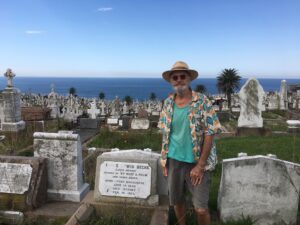
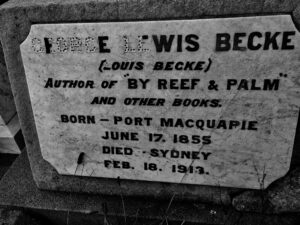 Louis Becke’s grave in Waverley cemetery Clovelly NSW: Not a bad spot to be buried maybe?
Frederick O’Brien (16 June 1869 – 9 January 1932) – Author of the original book White Shadows In The South Seas from which the silent film of the same name is adapted although bearing little resemblance to O’Brien’s book. His book was described “as a bitter denunciation of white civilization and its destructive effects on the lifestyles and cultural traditions of a Polynesian paradise.” Despite the serious underpinning, the book became a best seller and in 1928, directors Robert Flaherty and W.S. Van Dykemade a silent film of the book that remained true to the exotic, but dystopian theme.” O’Brien’s other book Mystic Isles Of The South Seas and Atolls Of The Sun are also in my opinion beautiful books although not as Tropical Gothic as the film version of White Shadows. While writing Mystic Isles and Atolls he lived with Charmaine London, widow of the writer Jack London. She said of O’Brien that he was “..the one man she loved after the death of Jack London.”
https://mikecooper.bandcamp.com/album/white-shadows-in-the-south-seas
My soundtrack for White Shadows In The South Seas was released on c.d. by Room40 records and I have performed it live around the world.
Greg Dening (1931-2008) was an Australian anthropologist / historian of the Pacific and its people and strangers that travelled there. Although not fiction his ‘stories’ are filled with real ‘tropical gothic’. Consider one of his books The Death Of William Gooch for instance –
“William Gooch died at Waimea on the island of Oahu in the Hawaiian chain. Pahupu, Hawaiian warriors ‘cut-in-two’ by their tattoos, killed him there. He was only twenty-two. A short life indeed.. Greg Dening uses the incident of his murder as the basis for a penetrating study of historical narrative and meaning in his book The Death Of William Gooch.
Gooch as a young astronomer set sail on board the Daedalus in August 1791. The Board of Longitude sent him to rendezvous with Captain George Vancouver at Nootka Sound. His aim was to join the mission to survey and chart the north west coast of America. However, Gooch never made contact with Vancouver and the Discovery. He died along with the ship’s Commander Richard Hergest and Manuel, a Portuguese sailor, at Waimea, on the island of Oahu on 12 May 1792, after an encounter with the Hawaiian Pahup. Around 1791 the historian Kamakau noted the emergence of a new breed of soldiers, “strange looking men with black tattoos from head to toe with eyelids turned inside out.” They were the pahupu, who had been recruited from Oahu by Kahekili, Kamehameha’s counterpart on Maui.
Lafcadio Hearn, also known by his adopted Japanese name Koizumi Yakumo, was a Greek born Irish writer who later adopted Japanese nationality and is perhaps best known for his collections of Japanese legends and ghost stories, such as Kwaidan: Stories and Studies of Strange Things. Incidentally there is a Lefkadio Hearn underground car park in Fort De France in Martinique. He spent two years living in St.Pierre prior to the destruction of the town by the volcano in 1902. The eruption of Mount Pelee killed 30,000 people and was the worst volcanic eruption in the 20th century. St Pierre never recovered and the capitol of Martinique is now Fort De France. Lefkadio died two years later in Japan where he is revered for his writings. You can read his book about Martinique Two Years In The French West Indies for free here…
https://www.gutenberg.org/files/6381/6381-h/6381-h.htm
Some contemporary film makers that I also consider to be ‘Tropical Gothic’ are Lav Diaz, Apichatpong Weerasethakul, Pedro Costa, Khavn De La Cruz and Kaneto Shindo. These names, perhaps not widely known, can easily be found on-line. My own videos are influenced by all of these directors in one way or another.
Lav Diaz is a Filipino independent film maker known for his very long, slow films. Apichatpong’s films combine the spirit world, mythology and politics of Thailand. Pedro Costa, although not strictly tropical being from Portugal, has for a number of years concerned himself with the Cabo Verdian (Cape Verde Islands) diaspora in Lisbon. Khavn De La Cruz is a flamboyant director who’s film Mondomanila is both bizarre and gothic. Both Onibaba and Kuroneko by Kaneto Shindo are two of my favourite Tropical Gothic films.
Three of my own ‘Tropical Gothic’ videos were shot in Hong Kong and on the island of Pulau Ubin, a small island between Singapore and Malaysia (see my web site for more information on those)
https://mikecooper.bandcamp.com/album/tropical-gothic-onibaba-legong-gods-of-bali
AMBIENT ELECTRONIC EXOTICA

Reluctant Swimmer/ Virtual Surfer was a live concert recording from the Controindicazione Festival of Improvised Music in 2003 in Rome. The first half is played on my old 1930s National tri-plate lapsteel guitar and the second half on my Vietnamese electric lap steel.
“He also sings two songs along the way. ‘’Movies is Magic’’ and “Dolphins”.. It was the first time Mike had ever sung the last song and the first time singing in an improvised music concert.
Really can’t think of many other 78 year old guitarists whose music still feels somehow relevant thru its sheer, expressive abstraction nowadays. And this recording proves; Mike Cooper is pretty special.”
“Floating in out of the exotic ether and disappearing like smoke, engulfed in the alien hugeness of nature… a very elegant set by a visionary artist.”
Originally released as a cdR on my Hipshot label it was released as a vinyl l.p. by Discrepant records with a wonderful cover designed by collagist Evan Crankshaw and is available as a digital download on my Bandcamp store.
https://mikecooper.bandcamp.com/album/mike-cooper-reluctant-swimmer-virtual-surfer
Check out Evan’s work and book


